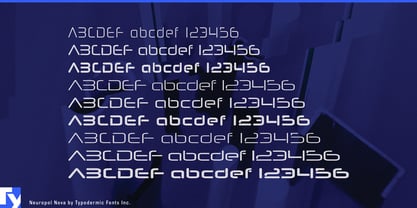
A lot of futuristic typography has become ordinary technology typography. Clean geometry, rounded corners, and wide proportions can signal software, mobility, or aerospace without making a project feel particularly distant from the present. Neuropol Nova is for situations where that distance matters.
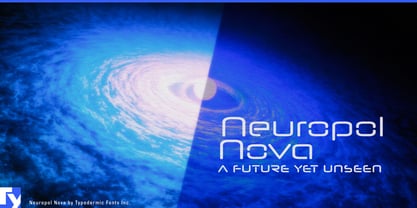
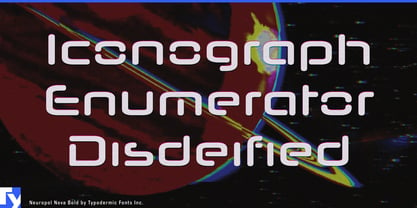
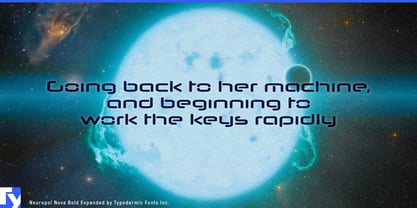
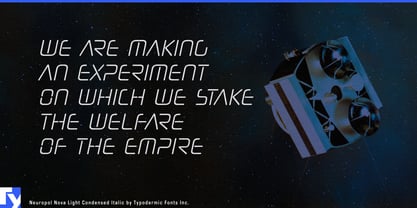
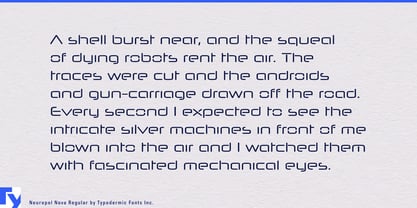
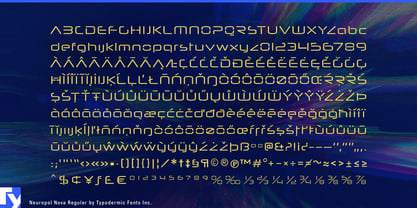
Its letterforms deliberately push familiar Latin shapes toward something more proprietary. Rounded construction, recurring stencil-like breaks, and unusually built capitals such as M, N, and W make ordinary words feel as though they belong to a technological culture with its own alphabet. The forms remain readable, but recognition takes a slightly less familiar route. That tension is the point.
Science-fiction production design is an especially natural setting. Feature films, streaming series, games, and themed entertainment need names for spacecraft, orbital facilities, artificial-intelligence systems, research divisions, colonies, corporations, vehicles, and manufactured objects. Neuropol Nova can give those names a shared visual language across hull graphics, environmental lettering, interface headings, equipment markings, promotional key art, and other elements that help turn a fictional setting into a coherent place.
The same quality can distinguish real technology that is supposed to feel ahead of the current market. Humanoid robotics, autonomous vehicles, experimental aerospace systems, fusion research, quantum hardware, and advanced mobility programs often need a conspicuous typographic layer for prototype names, research initiatives, concept vehicles, launch films, and exhibition graphics. A conventional corporate sans can handle the explanation; Neuropol Nova marks the part that is meant to feel unprecedented.
That division can be especially useful inside established companies. An aerospace manufacturer, automaker, or technology group may have a restrained corporate identity but still need a different voice for an experimental division or named R&D program. Neuropol Nova can function almost like a typographic codename system, separating the speculative project from everyday corporate communication without requiring an entirely unrelated identity.
Immersive environments offer another place for its unfamiliarity to work at scale. Space museums, science centres, technology experience centres, simulation venues, and futuristic attractions can use Neuropol Nova for exhibit titles, named zones, installations, portals, and wall-sized environmental typography. The lettering can feel as though it belongs inside the world being presented rather than simply describing that world from outside it.
Neuropol Nova is useful when familiar language needs to feel slightly estranged from the present: the name of a spacecraft that has never existed, a prototype intended to suggest what comes next, or an organization belonging to a world whose visual conventions have not been invented yet.