

Ignorer et passer au contenu
Accéder au contenu principal

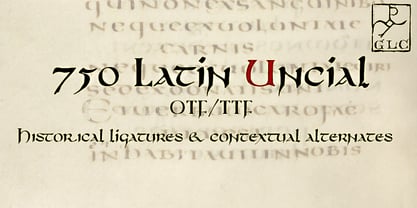
750 Latin Uncial

par GLC
Styles individuels à partir de $38.00 USD
La famille de polices 750 Latin Uncial a été conçue par Gilles Le Corre et publiée par GLC. 750 Latin Uncial contient 1 styles.

En savoir plus sur cette famille

À propos de la famille


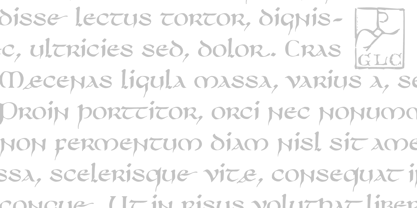
This font was inspired by the Latin script used in European monasteries from circa the 5th to 8th centuries, before the Carolingian “Caroline” (look at our 825 Karolus). It was a regular script, rounded, written slowly, used mainly for specially meticulous books, with a few ligatures, legible, but only with lowercase. The capitals consisted of enlarged lower cases, but here, we have preferred to use two slightly different patterns. Our lower cases are a synthesis from a lot of variants (mainly from the “First Bible” of Charles The Bald), the upper cases were mainly inspired from a 700’s manuscript from the abbey of Fécamp (France). We have adapted the font for contemporary users, differentiating between U and V, I and J, which has no relevance for ancient Latin scribes, and naturally with Thorn, Oslash, Lslash, K, W... punctuation and the usual accented characters which did not exist at the time. It can be used with 799 Insular Title.

Concepteurs: Gilles Le Corre

Éditeur: GLC

Fonderie: GLC

Maître d'ouvrage: GLC

MyFonts débout: Jun 9, 2010

750 Latin Uncial

À propos GLC

Gilles Le Corre was born in 1950 in Nantes, France. Painter since the end of 70s, he is also an engraver and calligrapher. He has been learning about medieval art and old books for as long as he can remember. More recently he has made the computer a tool for writing like the quill pen and ink. With it, he aims to make it possible to print books that look just like old ones! Beginning in 2007 he has been trying to reproduce, very exactly, a wide range of historic European typefaces, mainly from medieval and early periods of printing - his favorite period - from 1456 with Gutenberg, up to 1913 with a font inspired by a real old typewriter.

En savoir plus

Lire moins