



Ignorer et passer au contenu
Accéder au contenu principal

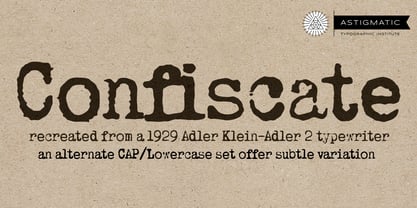
Confiscate AOE

par Astigmatic
Styles individuels à partir de $20.00 USD
La famille de polices Confiscate AOE a été conçue par Brian J. Bonislawsky et publiée par Astigmatic. Confiscate AOE contient 1 styles.

En savoir plus sur cette famille

À propos de la famille


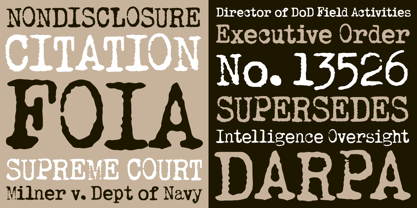
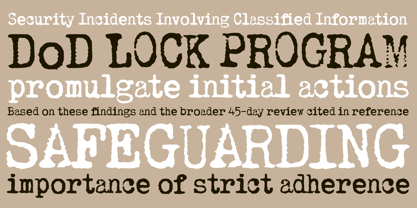
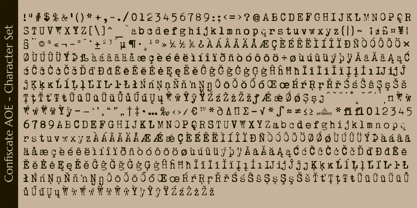
AOETI Document No. TYP-6/482-B Unauthorized Alphabetic Sample — Forensic Assessment: Confiscate AOE SUMMARY: Recovered letterforms exhibit characteristics consistent with compromised typewriter output using a 1929 Adler Klein-Adler 2 German-Finnish typewriter originating from Field Stations active between 1958–1967. Glyphs show severe erosion patterns, suggesting extended exposure to moisture, chemical agents, or covert transmission conditions. The sample is now designated “Corrosion Set / Variant B.” VISUAL ANALYSIS: Characters maintain a classic mechanical serif structure, but edges display significant ink bleed, fiber tearing, and particulate dispersal. These irregularities do not match standard machine malfunction; instead, they present as deliberate degradation, possibly introduced to obscure machine identity or sabotage forensic traceability. Notable anomalies include: • Uppercase Q and R: puncture-like voids along the vertical spine. • W, X, and Y: terminal fragmentation resembling burn patterns. • Lowercase g: asymmetrical ink pooling inconsistent with ribbon strike pressure. • Stylistic Alternates: repeated character strikes reveal alternate letterforms. These distortions indicate prolonged use of a compromised ribbon assembly or chemical interference applied post-impression. OPERATIONAL SUSPICION: Field analysts believe the alphabet may originate from covert communications routed through unregulated channels — abandoned safehouses, compromised couriers, or improvised print rooms. Fragmentation around the glyph edges suggests multiple re-ink attempts, likely during periods of electrical instability or under duress. BEHAVIORAL NOTES: Operators reported a persistent sense of unease when examining the sample, describing the letters as “corroded beyond their own memories.” While subjective, these reactions align with psychological responses observed in documents linked to high-risk intelligence failures. RISK EVALUATION: Moderate. While no latent chemical agents were detected, the sample’s condition implies deliberate concealment measures. Storing the alphabet in its current state may compromise legibility during future analysis. RECOMMENDATION: Catalog as Typewriter Forensic Class D / Distressed, with restricted handling. Treat the alphabet as evidence of a failed or sabotaged transmission chain. Maintain under archival quarantine until its origin can be fully established.

Concepteurs: Brian J. Bonislawsky

Éditeur: Astigmatic

Fonderie: Astigmatic

Maître d'ouvrage: Astigmatic

MyFonts débout: May 11, 2025

Confiscate AOE

À propos Astigmatic

In 1873, the strange and fantastic story began. Nearly two centuries later, Brian J. Bonislawsky was born, and carrying on a mix of the the footsteps his ancestors before him took, he picked up the the traditions and founded the Astigmatic One Eye Foundry, which later expanded to become the Astigmatic One Eye Typographic Institute. (For more of the background story, see the Historical Perspective link below.) Since its founding Astigmatic has worked with dozens of designers, helping them forge their own foundries as well as helping to increase the quality of type created by Astigmatic and these other foundries. Astigmatic strives to continually increase its range of typographic scope; taking on expeditions to revive old typestyles, unearth long lost typefaces, forge new styles yet unseen, and begin to develop more comprehensive language typestyles of the WGL4 set size which includes Greek and Cyrillic extensions. If you are looking for a wide variety of typographic influence and style, the Astigmatic One Eye Institute is your source for type.

En savoir plus

Lire moins