







Ignorer et passer au contenu
Accéder au contenu principal

Dai Vernon

par E-phemera
Styles individuels à partir de $20.00 USD
Famille complète de 2 polices: $35.00 USD
La famille de polices Dai Vernon a été conçue par Andrew Leman, Dai Vernon et publiée par E-phemera. Dai Vernon contient 2 styles et options de package familial.

En savoir plus sur cette famille

DaiVernon Legerdemain Set

2 polices

Meilleure offre!

Par style :

$17.50 USD

Paquet de 2 styles:

$35.00 USD

À propos de la famille


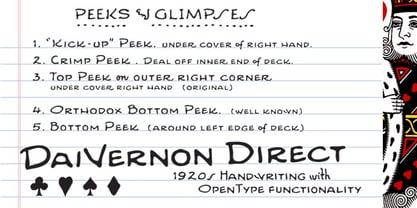
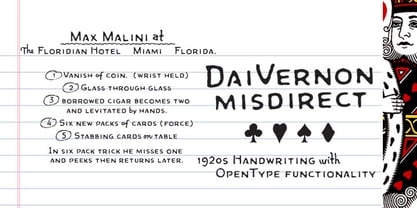
DaiVernon is based on the handwriting of card magician extraordinaire Dai Vernon. Known as "The Professor", Vernon was a beloved expert in sleight-of-hand and card magic. These fonts are based on the penmanship in his notebooks from the 1920s, which feature almost no lowercase letters. DaiVernon Direct is based on what appears to be his hastier style, while DaiVernon Misdirect is based on his neater hand. Numerous OpenType bonus glyphs, contextual alternates and discretionary ligatures help to create the feel of his handwriting. Thanks go to Michael Albright, David Ben, and Gene Matsuura for helping to provide access to Vernon's notebooks.

Concepteurs: Andrew Leman, Dai Vernon

Éditeur: E-phemera

Fonderie: E-phemera

Maître d'ouvrage: E-phemera

MyFonts débout: Feb 26, 2010

Dai Vernon

À propos E-phemera

E-phemera fonts are meant to revive type from years gone by in a way which captures the feeling of pre-digital printing technology. Most of the fonts in the collection were first developed for private use in designing vintage prop documents for movies and television shows. E-phemera fonts are inspired by old printed and hand-lettered material, and are usually designed a little rough and a little irregular, in deliberate defiance of the crisp perfection and merciless uniformity of modern digital fonts. Multiple letterforms and ligatures are provided, when possible and practical. We here at E-phemera fonts love computers and wouldn't do without them, but we also wish to remember and celebrate the days when every letter was an individual piece of metal or wood, and not just a collection of BCP data. Print is dead. Long live print!

En savoir plus

Lire moins