
Pular para o conteúdo
Pular para o conteúdo principal

Elite Gothic AOE

por Astigmatic
Estilos Individuais a partir de $20.00 USD
A família de fontes Elite Gothic AOE foi desenhada por Brian J. Bonislawsky e publicada pela Astigmatic. Elite Gothic AOE contém 1 estilos.

Saiba mais sobre esta família

Sobre a família


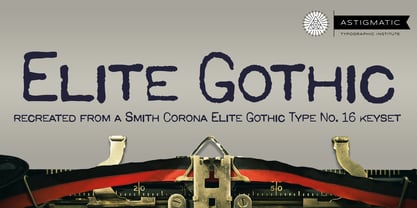
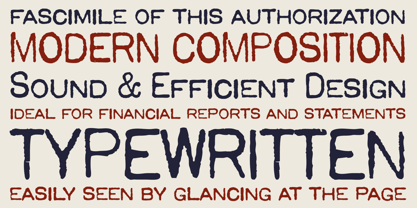
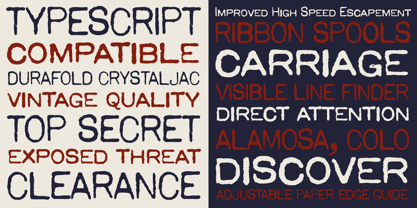
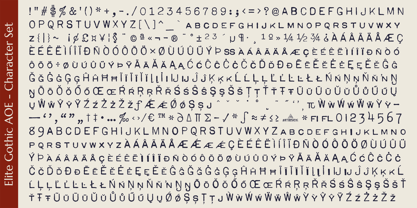
AOETI INTELLIGENCE DIVISION — UNEXPLAINED COMMUNICATIONS UNIT File No. CW-PARA/219-7 Recovered Alphabetic Sample: Elite Gothic AOE — Anomalous Origin SUMMARY: The following glyph set was recovered from a sealed transmission pouch discovered in an abandoned border relay station (Sector 12-K). Initial assumption classified the sample as degraded typewritten text similar to a Smith Corona Elite Gothic Type No. 16. Subsequent examination revealed irregularities incompatible with any known machine, ink, or operator technique. VISUAL FINDINGS: Each letterform maintains the proportions of standard Cold War field communication alphabets, yet the strokes exhibit organic wavering, as though influenced by unsteady hand or external vibration. The edges are marked by ink pooling and micro-ruptures consistent with neither mechanical impact nor conventional pen pressure. Notably, several characters contain unexplained distortions — the uppercase Q and R show elongated tails, while S, V, and Y appear subtly twisted, as if bent by unseen directional force at the moment of formation. ANOMALOUS CHARACTERISTICS: Forensic light scans detected faint oscillation patterns within the ink residue. These fluctuations exhibit low-frequency behavior inconsistent with environmental degradation. Technicians reported sensations of “pressure” or “static charge” when handling the sample. Further irregularities include: • Minor displacement in letter alignment, resembling micro-seismic interference. • Inconsistent stroke density, suggesting pulse-driven deposition rather than manual or mechanical writing. • A faint, persistent chemical signature with no match in current Soviet, NATO, or civilian ink registries. • Stylistic Alternates appear when enabled or when typing repeated letters. BEHAVIORAL REPORTS: Two analysts observing the text for extended periods reported a subjective impression that the letters were “leaning” or “adjusting,” despite no physical change. The sample was relocated to an isolated storage bay after personnel described a subtle feeling of being watched. ASSESSMENT: The alphabet is classified as Type Black / Unverified Cognitive Contaminant. It may represent an attempt at covert communication utilizing unstable materials or, as some researchers suggest, a nonstandard influence during the writing act. RECOMMENDATION: Do not reproduce. Do not trace. Limit visual exposure to under 90 seconds. Store under magnetic shielding until further directives are issued.

Designers: Brian J. Bonislawsky

Publicador: Astigmatic

Fundidoras: Astigmatic

Proprietário do design: Astigmatic

Estreia na MyFonts: May 7, 2025

Elite Gothic AOE

Sobre Astigmatic

In 1873, the strange and fantastic story began. Nearly two centuries later, Brian J. Bonislawsky was born, and carrying on a mix of the the footsteps his ancestors before him took, he picked up the the traditions and founded the Astigmatic One Eye Foundry, which later expanded to become the Astigmatic One Eye Typographic Institute. (For more of the background story, see the Historical Perspective link below.) Since its founding Astigmatic has worked with dozens of designers, helping them forge their own foundries as well as helping to increase the quality of type created by Astigmatic and these other foundries. Astigmatic strives to continually increase its range of typographic scope; taking on expeditions to revive old typestyles, unearth long lost typefaces, forge new styles yet unseen, and begin to develop more comprehensive language typestyles of the WGL4 set size which includes Greek and Cyrillic extensions. If you are looking for a wide variety of typographic influence and style, the Astigmatic One Eye Institute is your source for type.

Ler mais

Ler menos