






Pular para o conteúdo
Pular para o conteúdo principal

Kufi

por Diwan Software
Estilos Individuais a partir de $200.00 USD
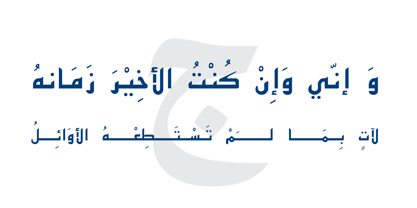
A família de fontes Kufi foi desenhada por Diwan Font Team e publicada pela Diwan Software. Kufi contém 1 estilos.

Saiba mais sobre esta família

Sobre a família


Kufi is an elegant standard Arabic Kufi style font that embodies the timeless beauty and precision of classical calligraphy. With its bold, geometric structure, it combines clean, straight lines and sharp angles, offering a sense of balance and order. The Kufi script, known for its historical roots in early Islamic manuscripts, is characterized by its distinct, square-shaped forms and uniform letter spacing. This font exudes sophistication and clarity, making it ideal for formal or decorative uses such as titles, logos, and high-end branding. Its refined, structured design offers both legibility and a sense of traditional elegance, seamlessly bridging the ancient with the modern.

Designers: Diwan Font Team

Publicador: Diwan Software

Fundidoras: Diwan Software

Proprietário do design: Diwan Software

Estreia na MyFonts: Nov 8, 2013

Kufi

Sobre Diwan Software

Diwan Software Ltd. is an established multilingual software company. Its technology has been used in millions of mobile devices worldwide and licensed by various international companies, from Apple Inc. to Zynga. Diwan owns one of the largest libraries of quality Arabic typefaces. It also produced the award-winning Mishafi font, one of the most advanced Arabic typefaces available.History: Starting around 1987, Diwan developed the Arabic fonts Damascus, Beirut, and Algiers. In the 1990s, Diwan worked on Arabic fonts with Apple for the Arabic Macintosh. Muna became one of the most popular fonts for Newspaper printing and book publishing. Nadeem was named after the son of the head of Apple Paris, who was managing the Arabic Macintosh. Then Diwan had to design an Arabic font that looked good on the screen but also worked well on the Apple LaserWriter printer. Font hinting at that time was mainly geared toward English fonts that are mostly straight lines. What was needed was a typeface that looked like modern Arabic typography but did not cause problems at small sizes on a LaserWriter. The result was Geeza, which Apple used on Mac OS X for many years.

Ler mais

Ler menos