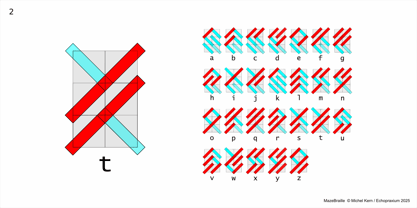
MazeBraille is a decorative, steganographic and lattice / grid typeface. The core design concept is that dot cells (in the 2x3 Braille grid) are represented as an upward diagonal while empty cells are represented as a downward diagonal (as illustrated by Poster 2: Glyph Anatomy). This design belongs to the Truchet category indeed it's inspired by the use of diagonal Commodore 64 graphic characters to draw a random maze with a single line of code.
This typeface is more suitable for very short texts (e.g. logos, acronyms, quotes, ambigrams, pangrams, palindromes, etc...) but on the other hand it may also be used for steganographic purpose like geocaching as well as fictive alphabets (e.g. Alien / SciFi / Fantasy / Antique civilizations).
* A graphic convention allows to differentiate uppercase from lowercase letter: in the uppercase glyphs there is thin lines (or polylines) in the gap between diagonals.
* Special characters (e.g. $()[].,;:&@# ...) are provided and follow the NABCC (North American Braille Computer Code) convention.
* Border glyphs are provided to make a decorative frame around the text (e.g. ASCII codes [192..199])
Posters
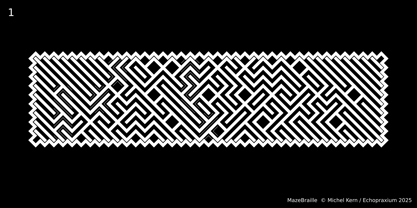
1. Font Logo: the displayed text is "Maze Braille" (Line 1) then "A Tile Decorative" (Line 2) and "Braille Typeface" (Line 3). The text is within a frame of "Border glyphs" (ASCII codes [192..199]).
2. Glyph Anatomy: illustrates the typeface design concept: The core design concept is that Braille dots are represented as an upward diagonal while empty cells (in the 2x3 Braille grid) are represented as a downward diagonal
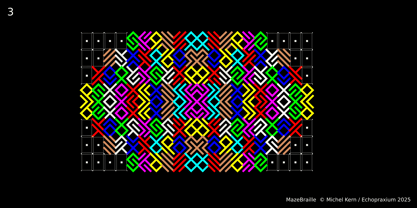
3. Kaleidoscope: this poster illustrates the lattice feature of MazeBraille. This illustration was easier to make by using the ' ‰ ' glyph ("per thousand" character, code 263), it is a placeholder for grid drawings.
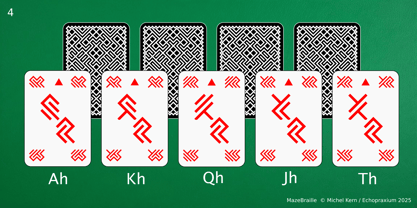
4. Playing Cards: here a Royal Flush is displayed by using the Acronym notation of the 52 playing cards deck:
[2..A] for the rank and { h, d, s, c } for the color (h: hearts, d: diamonds, s: spades, c: clubs).
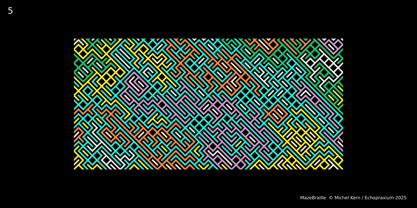
5. Maze: a short extract of the famous "I have a dream" speech of Martin Luther King. There is Colored paths which demonstrate the Maze feature of MazeBraille.
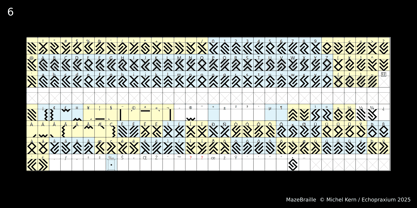
6. Glyph Map:
- The Blank Glyph is either ' ° ' (code 176) or ' µ ' (code 181)
- Border glyphs (ASCII codes [192..199])
- Symmetry groups (sets of symmetric characters, either a pair or a quadruplet) are easier to use or locate as they are all in the ASCII range [183..207]
- ' ‰ ' ("per thousand" character, code 263) is used as a placeholder to ease the making of illustration like Poster 3: Kaleidoscope.
Disclaimer
This typeface is not appropriate and not meant to print text documents in Braille for the blind readers audience.