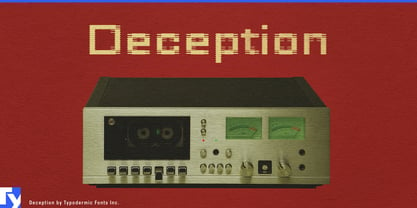
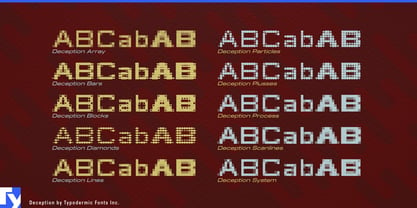
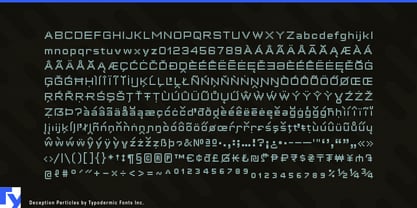
Images rarely arrive untouched. They are scanned, compressed, thresholded, enhanced, reconstructed, and sometimes fabricated. Projects concerned with uncertain visual evidence need typography that looks as though it has passed through the same systems. Deception converts a stable pixel alphabet into bands, blocks, particles, scanlines, and geometric fields, allowing the letters to carry traces of their own processing.
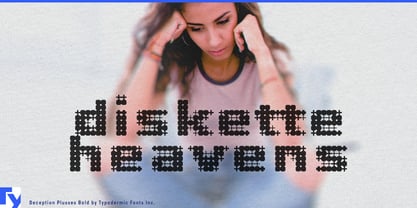
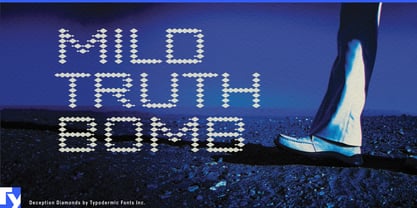
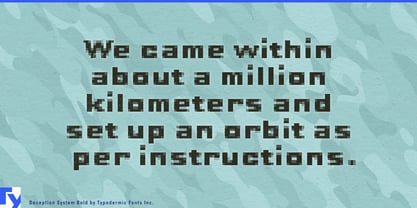
The family begins with four master pixel shapes and four tonal levels. Ten visual treatments translate that structure into dot fields, halftone bands, thermal-looking streaks, diamonds, grids, and scrambled textures. The letterforms remain consistent, so a design can move between different kinds of signal without abandoning its identity.
Media authenticity and digital forensics provide the strongest territory. Deepfake detection, content provenance, identity fraud, disinformation research, cybersecurity investigations, and media-literacy programs all deal with information whose origin or integrity is in doubt. Deception can give conference identities, documentary titles, report covers, awareness campaigns, and investigative graphics a processed surface that supports the subject.
Scientific imaging offers an equally convincing use. Satellite observation, weather radar, microscopy, medical imaging, ocean mapping, climate modeling, and remote sensing translate phenomena into pixels, bands, thresholds, and tonal fields. Research conferences, museum exhibits, instrument launches, educational animations, dataset publications, and large report titles can connect the typography with the captured evidence.
Camera and scanner manufacturers, display companies, digital-printing systems, machine-vision firms, and visual-effects studios can extend the same language into product communication. Trade-show graphics, demonstration reels, technical case studies, and launch campaigns can shift between treatments to suggest capture, processing, output, and interference. Museums and archives can apply the same vocabulary to exhibitions about computer graphics, electronic displays, telecommunications, digital preservation, and the history of recorded images.
Motion and large-format display reveal the family’s full range. A word can pass through bars, blocks, particles, diamonds, and scanlines across an LED wall, title sequence, projection, or interactive installation. A clean companion should carry data, instructions, captions, and dense reading; Deception handles titles, section openers, campaign language, stage graphics, and short display passages where processing is part of the message.