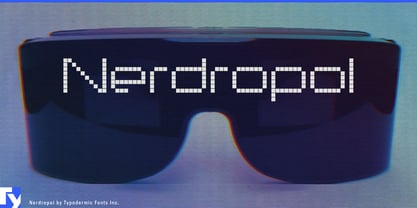
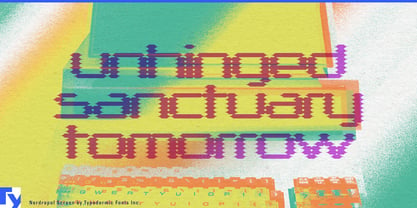
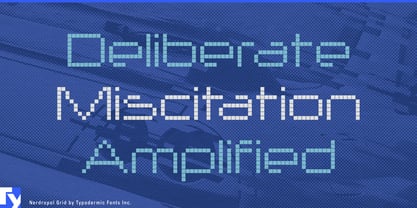
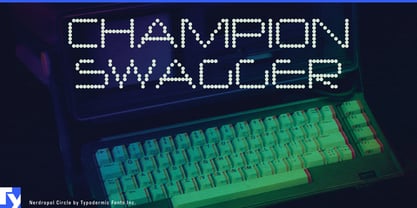
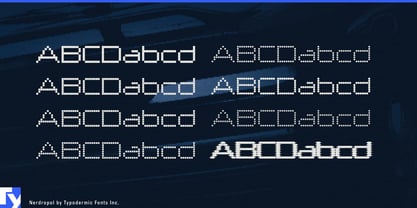
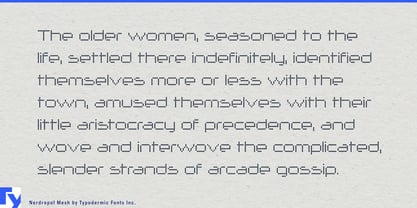
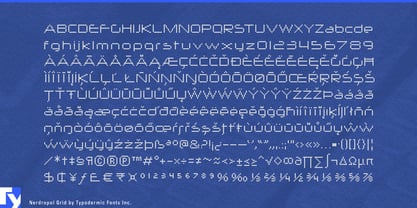
Pixel typography usually comes bundled with nostalgia. That becomes a problem when the subject is a contemporary LED wall, image sensor, virtual-production stage or responsive light installation rather than an old arcade cabinet. Nerdropol keeps the discipline of a pixel grid but applies it to slender geometric forms, giving designers a way to work with visible digital structure without automatically turning the project into an 8-bit revival.
Display technology is one of its strongest territories. MicroLED systems, modular LED walls, digital-signage hardware, video processors and pixel-mapping platforms are built around arrays of discrete light sources. Nerdropol can carry product-series names, technology-demo headings, trade-show walls and launch graphics in typography that reflects the equipment itself. Its eight coordinated styles reinterpret the same underlying design through dots, grids, lattice structures, screen effects and other modular treatments.
Live events and virtual production push that idea into larger spaces. Automotive launches, technology conferences, arena presentations and immersive exhibitions increasingly rely on programmable display surfaces. Nerdropol can handle stage titles, zone names, countdowns and motion-graphic headings while a clean sans serif carries schedules, specifications and longer information. LED-volume studios, real-time production systems and media-server companies can use the same language for demo reels, product graphics and conference environments where typography is literally surrounded by pixels.
Machine vision and imaging hardware provide another natural setting. Industrial cameras, image sensors, depth-camera systems, optical inspection equipment and computer-vision platforms all begin with sampled visual information arranged into grids. Nerdropol can give sensor names, product families, demonstration graphics and trade-show displays a direct relationship to that underlying structure without resorting to circuit-board patterns or generic futuristic lettering.
Programmable-light architecture offers a forward-looking extension. Media façades, responsive installations, exhibition pavilions and public lighting systems increasingly treat walls and buildings as low-resolution displays. Nerdropol can identify these projects in presentations, environmental graphics and promotional material, while its modular constructions echo the nodes and arrays from which the installations are assembled. Drone-light shows and robotic-light performances provide a related role for event titles and sponsor graphics.
Games remain part of Nerdropol’s territory without having to define it. Game titles, tournament packages, stage names, boot sequences and hardware-inspired interface moments can use its pixel construction when the digital grid is intentionally visible. Nerdropol works best where a few words need to feel built from the display system itself: product names, stage titles, zone identifiers, large numerical callouts and animated headings.