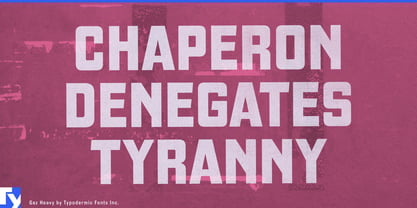
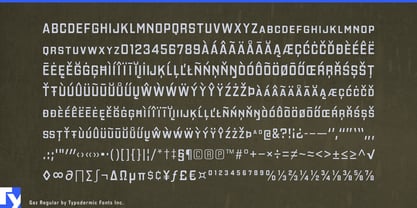
Repair is becoming part of the product again. Equipment makers, mobility companies, apparel brands, and public infrastructure operators increasingly need to show that something can be serviced, refurbished, upgraded, and returned to work. The typography around those systems often falls into two familiar camps: anonymous industrial sans serifs or fake garage nostalgia. Gaz offers a third route. Its compact service-station lettering carries an old-fashioned machine-shop flavor that can point forward as easily as backward.
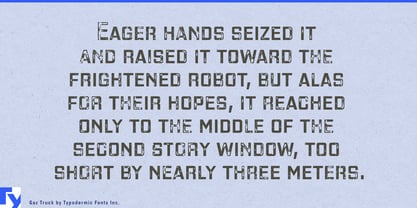
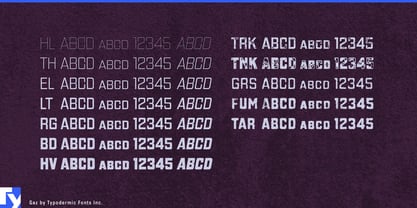
That makes Gaz particularly useful for certified repair and refurbishment programs. Appliance manufacturers, electronics companies, professional-tool brands, e-bike makers, outdoor-equipment companies, and durable-goods manufacturers can use it for repair centers, recertified products, parts departments, trade-in programs, inspection labels, service cards, workshop signs, shipping cartons, and campaign graphics. The clean styles can establish the permanent identity; the distressed companions can distinguish repaired, reconditioned, field-tested, archive, or service material.
EV and e-bike infrastructure extends that service vocabulary into the near future. Charging hubs, battery-diagnostic centers, e-bike service depots, commercial fleet workshops, battery-swap facilities, roadside-assistance networks, tire centers, and travel plazas built around fast charging all inherit some of the functional role once played by the filling station. Gaz can handle service-bay graphics, zone names, maintenance vehicles, uniforms, merchandise, roadside campaigns, and non-critical directional graphics while giving the environment more character than a generic technology identity.
The same idea extends naturally into circular-economy infrastructure. Repair pavilions, electronics refurbishment centers, building-material reuse depots, municipal repair facilities, university fabrication labs, tool-lending centers, appliance-recovery operations, and larger circular-economy campuses need visual identities that communicate useful work rather than abstract sustainability. Gaz makes a repair bench, parts locker, battery station, or reclaimed-material warehouse feel like part of a working civic system.
Maintainable green machinery provides another forward-looking application. Autonomous tractors, robotic weeders, orchard machines, greenhouse equipment, municipal cleaning robots, irrigation systems, inspection machines, field-service drones, and other equipment designed around replaceable modules and long service lives can use Gaz for model names, battery units, access panels, transport cases, maintenance graphics, dealer material, and trade-show displays.
Traditional workshop products remain part of the same world: rust treatments, greases, coolants, tire-repair systems, diagnostic equipment, battery-service tools, service lifts, parts washers, maintenance kits, workshop storage, shop chemicals, and fleet-service products all have a legitimate reason to use Gaz.
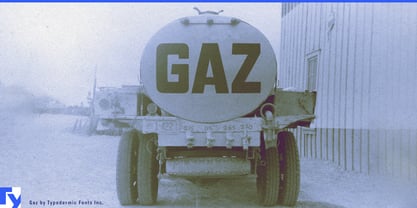
Gaz grew from mid-century gasoline-station and service lettering, but its future does not depend on nostalgia for gasoline, barbershops, or reclaimed wood. Its real subject is maintenance. It gives repair programs, roadside infrastructure, circular-economy facilities, service businesses, and maintainable machinery a compact industrial voice that makes the future look built to be fixed.