
Skip to content
Skip to main content

Octomorse Basic22 R1

by Octomorse
Individual Styles from $50.00 USD
The Octomorse Basic22 R1 Font Family was designed by Federico Lucas Köhn and published by Octomorse. Octomorse Basic22 R1 contains 1 styles.

More about this family

About the family


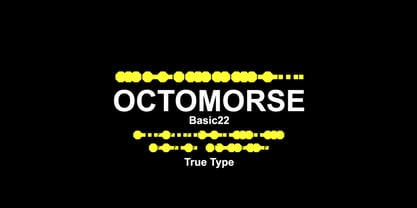
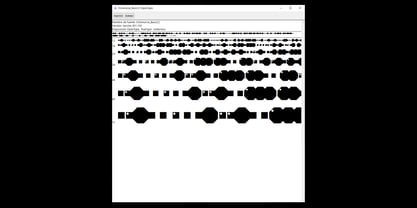
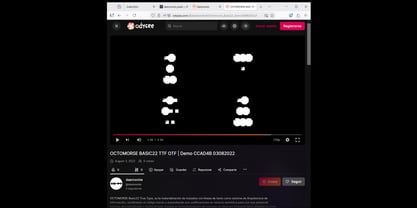
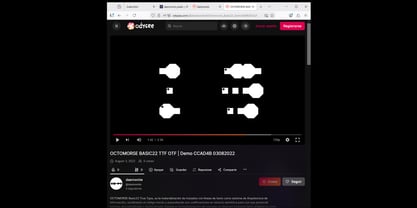
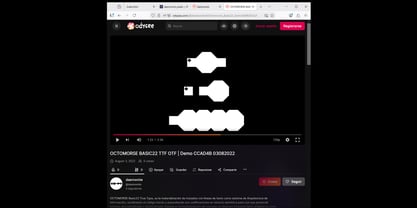
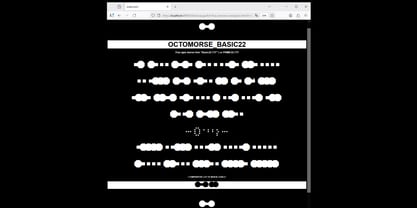
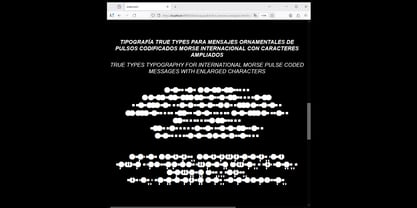
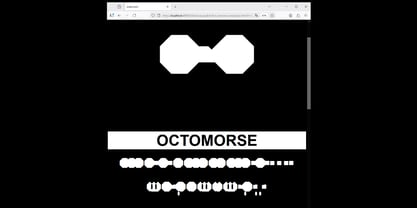
Octomorse was designed as an expanded character set compared to the international standard Morse code, acting as an encoder and encryptor of textual information, both simple linear messages and other sequences derivable from pulse or frequency modules. This recently developed and launched typeface comes in two styles, called "Basic22" and "Prime22." The written result is a cryptic and artificial graphic style, with an octagonal rectangular geometric base suitable for graffiti and engraving tapestries, boards, and matrices on all types of surfaces or corporeal objects. This favors a minimalist ornamental aesthetic, oriented toward the art of code and functionalizing messages and phrases as abstract structures of articulated pulses, whether before human observers or other analog-digital interpreters for translation and assistance, expanding the readability experience of the telematic type in which it is printed and expressed.

Designers: Federico Lucas Köhn

Publisher: Octomorse

Foundry: Octomorse

Design Owner: Octomorse

MyFonts debut: Sep 5, 2025

Octomorse Basic22 R1

About Octomorse

Octomorse was designed as an expanded character set compared to the international standard Morse code, acting as an encoder and encryptor of textual information, both simple linear messages and other sequences derivable from pulse or frequency modules. This recently developed and launched typeface comes in two styles, called "Basic22" and "Prime22." The written result is a cryptic and artificial graphic style, with an octagonal rectangular geometric base suitable for graffiti and engraving tapestries, boards, and matrices on all types of surfaces or corporeal objects. This favors a minimalist ornamental aesthetic, oriented toward the art of code and functionalizing messages and phrases as abstract structures of articulated pulses, whether before human observers or other analog-digital interpreters for translation and assistance, expanding the readability experience of the telematic type in which it is printed and expressed.

Read more

Read less