Skip to content
Skip to main content

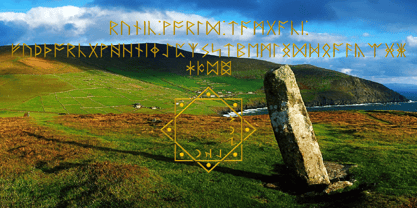
Ongunkan Anglo Saxon Runic

by Runic World Tamgacı
Individual Styles from $75.00 USD
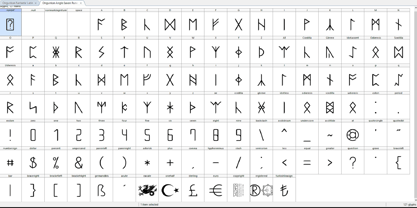
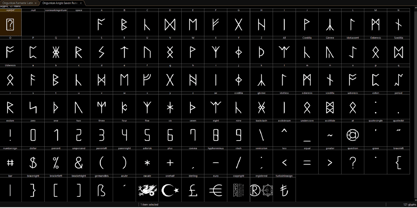
The Ongunkan Anglo Saxon Runic Font Family was designed by Osman Nuri ALKAN and published by Runic World Tamgacı. Ongunkan Anglo Saxon Runic contains 1 styles. More about this family

About the family


Anglo-Saxon runes or Anglo-Frisian runes are runes that were used by the Anglo-Saxons and Medieval Frisians (collectively called Anglo-Frisians) as an alphabet in their native writing system, recording both Old English and Old Frisian (Old English: rūna, ᚱᚢᚾᚪ, "rune"). Today, the characters are known collectively as the futhorc (ᚠᚢᚦᚩᚱᚳ, fuþorc) from the sound values of the first six runes. The futhorc was a development from the older co-Germanic 24-character runic alphabet, known today as Elder Futhark, expanding to 28 characters in its older form and up to 34 characters in its younger form. In contemporary Scandinavia, the Elder Futhark developed into a shorter 16-character alphabet, today simply called Younger Futhark.

Use of the Anglo-Frisian runes is likely to have started in the 5th century onward and they continued to see use into the High Middle Ages. They were later accompanied and eventually overtaken by the Old English Latin alphabet introduced to Anglo-Saxon England by missionaries. Futhorc runes were no longer in common use by the eleventh century.

The Anglo-Frisian runic row was a 28-type further development of the 24-type Elder Futhark (type = number of runes), introducing more runes and reworking some existing runes to fit the period language. Starting from around the 5th century, it was used in Britain and Frisia as part of the diffuse Anglo-Frisian cultured sphere. Around the 8th century, runic writing disappears from Frisia, but use continues in Britain.

In the 9th century, the now Anglo-Saxon runic row, was further developed and more runes were introduced, eventually becoming a 33-type runic row with some further unstandardized examples of runes existing. In its late stage, it was largely analogous to the Latin script, and disappeared in its favour during the High Middle Ages.

Usage and commonality is unclear. From at least five centuries of use, fewer than 200 artifacts bearing futhorc inscriptions have survived.

Designers: Osman Nuri ALKAN

Foundry: Runic World Tamgacı

MyFonts debut: Sep 12, 2025

Ongunkan Anglo Saxon Runic

About Runic World Tamgacı

As my interest in rune writings grew, it became inevitable for me to make my own fonts. It was time to put all these years of hard work into action. This foundry, named Runic World Tamgacı, was prepared as a platform for the distribution of font studies developed on Old European Runic inscriptions, Old Asian Runic inscriptions, Old Hungarian Runic inscriptions, Runic inscriptions found in Africa and Arabian geography, and Italic inscriptions such as Etruscan and Iberian. These fonts, which have high aesthetic design and a full list of letters, will serve as a wide source especially for academic studies and amateur researchers, including derivative letters. It will also please enthusiasts interested in this field. The inventory of the foundry will be constantly updated and expanded with new additions to the fonts of these mysterious ancient inscriptions. These Runic studies were made from scratch by looking at the relevant sources.

Read more

Read less