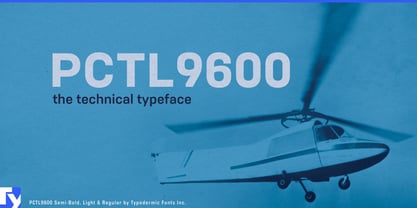
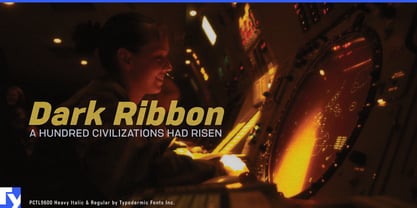
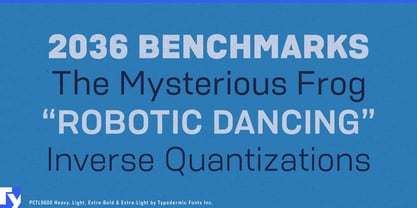
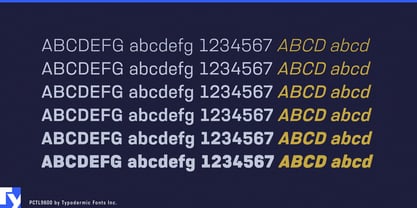
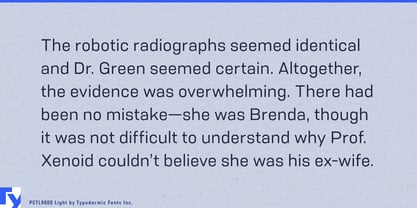
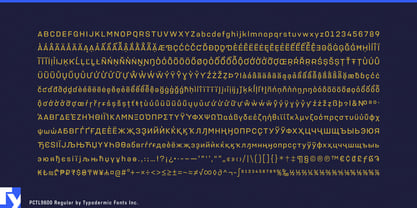
PCTL9600 began as a custom typeface for a science-fiction video game, with a brief to carry DIN’s disciplined utility into a more futuristic, engineered setting. Its squared forms and abrupt transitions move beyond DIN’s geometric character toward contemporary industrial design, recalling instrument housings, molded components, control surfaces and replaceable cartridges. The result is orderly enough for complex information, yet distinctive enough to establish a proprietary technical environment.
PCTL9600 shares its underlying construction with PCTL4800, but removes the indexed corner cuts of its companion family. The uninterrupted forms give it a quieter, more broadly applicable character without softening its industrial edge. It feels designed for a specific technical system, though less conspicuously marked by one.
This balance makes PCTL9600 particularly effective for pharmaceutical and biotechnology products. Specialty-drug cartons, diagnostic-test kits, laboratory reagents and clinical-trial materials can use it for product names, formulation codes, dosage strengths and information headings. It communicates scientific precision without becoming another anonymous healthcare sans, while its cleaner construction accommodates products that require a restrained visual identity.
The same qualities suit laboratory instruments, medical devices, synthesizer control panels, robotics catalogs, 3D-printer packaging and field-service manuals. Model names, equipment categories, specifications, labels and procedural text can share a consistent industrial language without making every component look like a science-fiction prop.
In speculative settings, that restraint becomes an advantage. Spacecraft maintenance labels, mission dossiers, cockpit displays, research-station signs and operating instructions often need to appear routine within their fictional world. PCTL9600 suggests contemporary engineering without calling attention to a decorative futuristic device, making it especially useful for the background typography that turns an imagined technology into established infrastructure.
PCTL4800 offers the same industrial foundation with indexed corners inspired by memory cards and technical components. PCTL has no inherent meaning, while 9600 was loosely inspired by the model-number language of old Atari consoles. It sounds less like a typeface than a piece of equipment already several revisions into production.