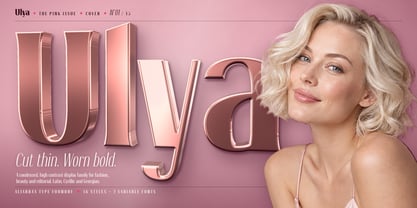
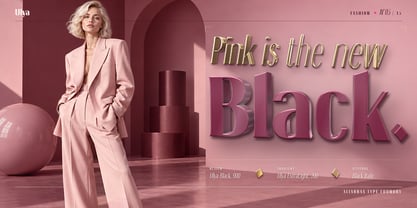
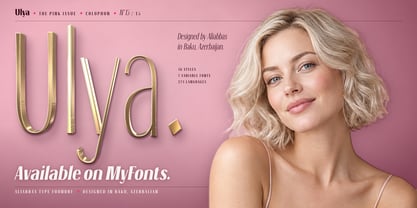
Ulya is a condensed display family with high contrast, drawn in Baku for fashion, beauty, editorial and brand work. Its stems are tall and firm, its hairlines very thin, and the two never blur into each other: the stress is strictly vertical.
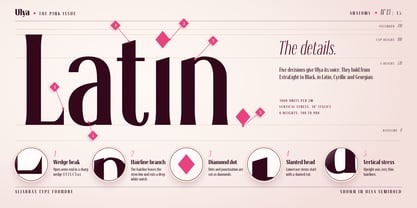
Three details give Ulya its voice. Where an arch or a bowl leaves a stem, in n, h, m, u, r, b, d, p, q, a and g, the hairline branches low and leaves a deep white notch. Open arms and terminals end in a sharp wedge beak. Dots and punctuation are cut as diamonds. Lowercase stems carry slanted heads, capitals stand on flat, slightly flared ends.
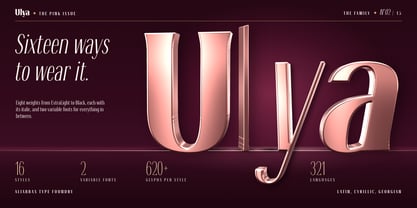
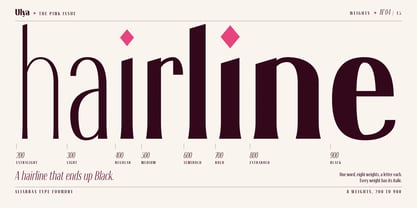
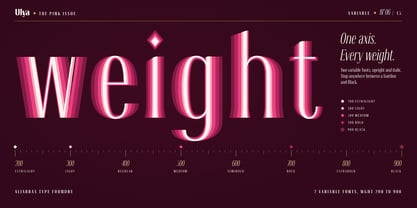
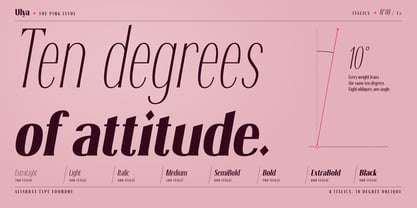
The family comes in 8 weights, from a fine ExtraLight to a dense Black, each with an italic slanted at 10 degrees. Two variable fonts, upright and italic, cover every weight in between on one axis from 200 to 900. Every weight is drawn from the same construction, so the hairline logic stays intact from the thinnest to the heaviest style.
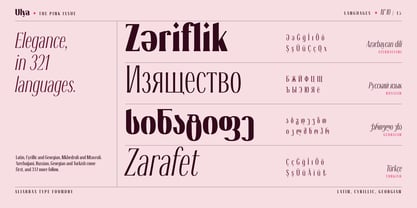
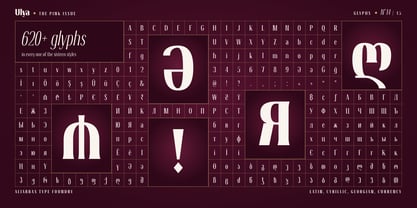
Ulya was built for Azerbaijani, Turkish, Russian and Georgian first: Ə, Ğ, Ş, Ç and the dotted and dotless i were drawn with the base alphabet, not added later. The character set has 624 glyphs and covers 321 languages in three scripts: Latin with Latin Extended-A, Cyrillic (Russian, Ukrainian, Belarusian, Bulgarian, Serbian, Macedonian, Kazakh) and Georgian (Mkhedruli with Mtavruli capitals).
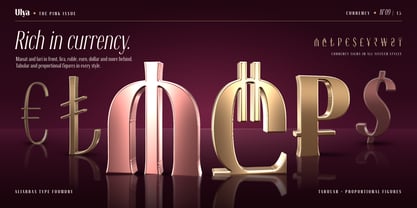
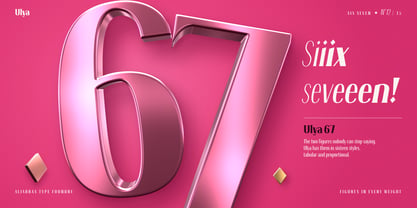
Figures are tabular by default and proportional with pnum. The currency set includes the Manat, Lari, Lira, Ruble, Hryvnia, Tenge, Euro, Pound, Dollar and Yen. Kerning is measured from the outlines in all three scripts, and combining accents attach through the mark feature.
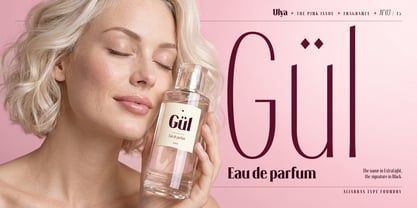
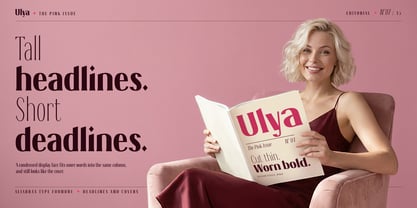
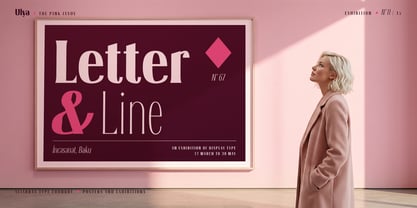
Ulya is at its best large: mastheads, campaign headlines, packaging, posters and titles.