






Ignorer et passer au contenu
Accéder au contenu principal

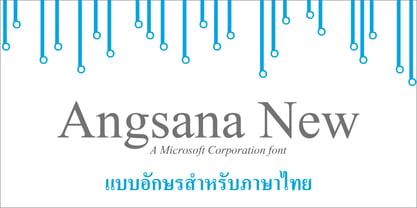
Angsana New

par Microsoft Corporation
Styles individuels à partir de $49.00 USD
Famille complète de 4 polices: $129.00 USD
La famille de polices Angsana New a été conçue par Steve Matteson, Microsoft et publiée par Microsoft Corporation. Angsana New contient 4 styles et options de package familial.

En savoir plus sur cette famille

À propos de la famille


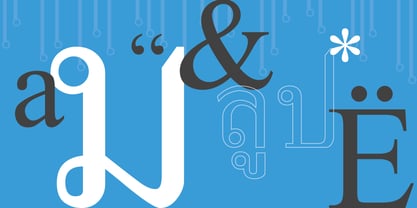
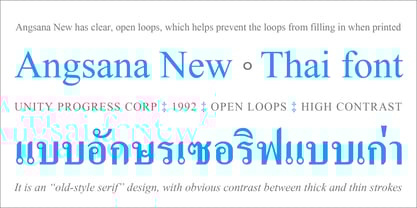
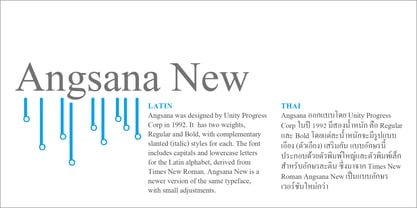
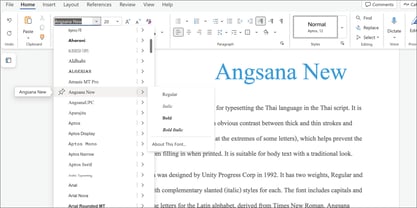
"Angsana is a typeface designed for typesetting the Thai language in the Thai script. It is an “old-style serif” design, with obvious contrast between thick and thin strokes and clear, open loops (small circles at the extremes of some letters), which helps prevent the loops from filling in when printed. It is suitable for body text with a traditional look. Angsana was designed by Unity Progress Corp in 1992. It has two weights, Regular and Bold, with complementary slanted (italic) styles for each. The font includes capitals and lowercase letters for the Latin alphabet, derived from Times New Roman. Angsana New is a newer version of the same typeface, with small adjustments."

Concepteurs: Steve Matteson, Microsoft

Éditeur: Microsoft Corporation

Fonderie: Microsoft Corporation

Maître d'ouvrage: Microsoft Corporation

MyFonts débout: Jun 15, 2011

Angsana New

À propos Microsoft Corporation

The Typography Group at Microsoft is responsible for both fonts and the font rendering systems in Windows. Since version 3.1 the primary font system built into Windows has been the TrueType system, licensed from Apple in a deal (with hindsight) remarkably beneficial to Microsoft. Working with Monotype, the Microsoft Typography Group produced fine TrueType versions of Arial, Times New Roman and Courier New, tuned to be extremely legible on the screen; these were all ready for the launch of Windows 3.1. Since then these core fonts have been developed to cover more and more of the world’s languages. In the mid-1990s under Robert Norton a program of truly new type designs was begun, using TrueType technology to render faithfully the bitmaps and outlines designed by Matthew Carter (Verdana, Georgia, Tahoma) and by in-house designer Vincent Connare (Trebuchet, Comic Sans). Until August 2002 these “core fonts” were offered freely over the Web, where they made an undoubtedly positive contribution in terms of legibility and font choice. In 1996 the OpenType initiative with Adobe was announced; this is touted as the end of the font wars’, whereby advanced multilingual text layout becomes available, native rendering of PostScript fonts becomes part of Windows 2000, and unwieldy font formats are rationalized. In 1998 the group announced ClearType. This is a very ingenious method to increase legibility on color LCD screens, individually targeting the 3 subpixels (red, green and blue) that make up each pixel. Such a leap forward in readability on these screens is a crucial element to the success of nascent eBook technology. Simon Daniels at the Group’s website keeps font fans and font developers up to date with most aspects of the digital typography scene, and communicates the technicalities of how fonts work in Windows. Updating us about the current (October 2000) activity of the Group, Simon notes: 1999 saw several members of the group leave to join Microsoft’s eBooks group. These included technical lead Greg Hitchcock, developers Beat Stamm and Paul Linerud as well as former Monotype hinters Michael Duggan and Geraldine Wade. The past twelve months has beeen a rebuilding period for the group, with numerous new hires [sic.] replacing earlier departures. The Group continues to provide font related services for Microsoft, and freely licensed tools and technology to the wider type development community. On August 12, 2002 Microsoft discontinued the free availability of the “core fonts”, noting that “the downloads were being abused” in terms of their end-user license agreements. Most commentators took this to mean the company objected to the fact that the fonts were being installed with Linux distributions.

En savoir plus

Lire moins